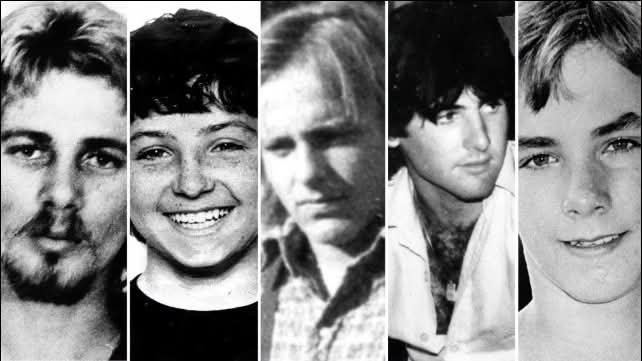
Before their names became part of a murder investigation, they belonged to families, friendships and everyday lives. Their memorial pages preserve those memories. This story brings together what is publicly known about the cases and the long search for answers.
Between 1979 and 1983, five young men and boys were murdered in South Australia in cases police have linked. Bevan Spencer von Einem was convicted of Richard Kelvin’s murder in 1984. No one has been convicted of the murders of Alan Barnes, Neil Muir, Peter Stogneff or Mark Langley.
Background
The name and the wider pattern
“The Family” is the name used in reporting and police appeals for an alleged network linked to the abduction, sexual abuse and murder of boys and young men. The five people remembered here were aged between 14 and 25. The familiar label does not establish who belonged to a network or what any individual did.
ABC traces the name to a detective’s reference to breaking up a “happy family” in a 1988 television interview. The crimes became known collectively as the Family Murders, but the evidence and legal outcome must still be considered separately in each case.
Abduction, drugs and captivity
The independent research website familymurders.com describes alleged methods of approaching young people, including offers of lifts or invitations to parties, followed by drugged drinks and sexual assault. These descriptions are secondary accounts of alleged offending; they do not establish that every disappearance followed the same pattern or prove the involvement of a particular associate.
In Richard Kelvin’s case, ABC’s account of the court documents records that he was held captive for five weeks. Alcohol and sedatives were found in his system. The report also describes alcohol and sedatives in Alan Barnes’s case, and sedatives in Mark Langley’s. These findings help explain why investigators examined connections between the cases; they do not identify every person responsible.
01 · The five lives
From 1979 to 1983
June 1979
Alan Barnes
Alan was reported missing on 18 June 1979 after he did not return from visiting a friend. His body was found on 24 June beneath the South Para Bridge near Williamstown. Investigators concluded that he had been killed somewhere else; that location remains unidentified in the official profile.
His movements in the intervening days are incomplete. Crime Stoppers describes several unconfirmed sightings and one sighting police considered credible: Alan with two other males on the evening before his body was found. The profile does not identify them.
August 1979
Neil Muir
Neil, 25, lived on Carrington Street in Adelaide. His last movements have not been established. On 28 August 1979, two people fishing near Mutton Cove at Osborne found his remains in the Port River and contacted police.
A man was charged during the original investigation and acquitted after a Supreme Court trial in 1980. That acquittal is part of the case history and must be recorded accurately. Neil’s murder remains unresolved.
August 1981 – June 1982
Peter Stogneff
Peter was 14. He planned a day away from school and a meeting with his cousin in Rundle Mall, but his cousin’s plans changed. Whether Peter reached the city is still unknown. His parents reported him missing on 27 August 1981.
On 22 June 1982, a farmer found remains near Middle Beach Road, Two Wells, and contacted police the following morning. They were identified as Peter’s. Investigators also received information suggesting Peter might have been seen with an adult man at Tea Tree Plaza on the day he disappeared. The 2021 appeal describes a possible sighting, not a confirmed journey, and says the man had not been identified.
February – March 1982
Mark Langley
Mark, 18, attended an eighteenth-birthday party in Windsor Gardens on Saturday 27 February 1982. The official account describes him leaving at about 1.15am with two friends in a white Datsun 1600. They drove to War Memorial Drive beside the River Torrens.
After a disagreement, Mark left the car and walked along the northern side of the road. His friends drove away, returned a few minutes later and could not find him. His body was found beside Sprigg Road at Summertown on 8 March. Police concluded that he had been killed elsewhere.
June – July 1983
Richard Kelvin
Richard was 15 when he was abducted from a laneway off Ward Street, North Adelaide, at about 6.15pm on 5 June 1983. Witnesses heard raised voices and a car with a loud exhaust leaving. The car has not been identified in the official appeal.
Investigators believe Richard was held for approximately five weeks. His body was found near a dirt airstrip at Kersbrook on 24 July. Bevan Spencer von Einem was convicted of his murder. The 2020 police appeal nevertheless says investigators believe more than one person participated in the abduction and murder. That belief about other people is distinct from the conviction.
02 · Investigation and courts
One conviction, continuing questions
In Richard’s case, the prosecution relied on scientific evidence connecting him with von Einem. Von Einem denied the charge but a jury found him guilty, and he received a life sentence. Later charges concerning Alan and Mark did not result in convictions: ABC’s retrospective reports that they were dropped after a ruling excluded some evidence from use at trial.
Von Einem’s original non-parole period was 24 years. ABC reports that this was increased to 36 years on appeal in March 1985. Both figures describe non-parole periods; the sentence itself was life imprisonment.
What the contemporary reports show
The Canberra Times’ November 1984 sentencing report records the judge’s view that von Einem had an accomplice or accomplices. It also reports that the judge could not determine whether von Einem personally killed Richard or was present at that moment, but found that he had set the venture in motion. This is an account of the sentencing remarks, not a finding about the identity of any other person.
A report published on 2 February 1991 distinguishes the later cases. It says Mark’s charge was dropped after a December evidentiary ruling, while the Crown discontinued Alan’s charge the previous day. The Attorney-General said legal advice found no reasonable prospect of conviction on the admissible evidence then available. Discontinuing a prosecution and an acquittal after trial are different outcomes; neither case produced a conviction.
What police said about other participants
The question of accomplices is part of the public investigative record. In its 2020 appeal, Crime Stoppers SA states that investigators were convinced more than one person was involved in Richard Kelvin’s abduction.
In October 2008, ABC PM reported a Major Crime review, further interviews and DNA sampling of some suspects. The report described four people under suspicion. Superintendent John Venditto said their degrees of culpability might vary, and police discussed possible immunity for someone who supplied information. This was a description of the investigation in 2008, not a current headcount of a network or a finding that everyone suspected had the same role.
These public statements support the continuing search for other participants. They do not establish a complete list of offenders or prove who carried out each act. A person’s occupation or association with von Einem does not, by itself, establish criminal involvement.
The report documents work undertaken at that time. It does not establish what later testing found, or which exhibits remain suitable for examination today.
Von Einem’s death
The Coroners Court’s finding of 28 August 2026 confirms that von Einem died at Yatala Labour Prison on 5 December 2025, aged 79, from complications of metastatic cancer with other health conditions. The inquest concerned his death in custody; it did not resolve the other murders.
03 · The families
Remembering, and asking for answers
Family voices add something a chronology cannot. In the 2019 podcast episode Neil Muir Was My Father, Neil’s daughter Sonya speaks about her memories of him, the love of his family and friends, and the impact of his death. These are personal recollections, with value in their own right.
In September 2026, Robyn Barnes, Alan’s sister, sought 500,000 signatures with support from other victims’ families. The campaign asks for a lawful review of suppression orders. SA Police opposed lifting the orders, citing evidence preservation, witness confidentiality and potential prejudice to justice. Police also told ABC that investigations into all five murders remained open.
A Supreme Court spokesperson explained that a petition is not required to apply for revocation. The signature target expresses public support; reaching it does not automatically lift an order.
What can change an order?
Section 69A of the Evidence Act 1929 recognises open justice while allowing suppression in specified circumstances. Under section 69A(6), the court that made an order may vary or revoke it on an application by a person within section 69A(5)(a). That includes a person the court considers to have a proper interest. The individual order and the grounds for changing it still need to be examined.
Debi Marshall described her continuing work with senior legal figures in a September 2026 interview. She explained that suppressions can concern witnesses and informants as well as suspects, and that the effort was directed at lifting at least some restrictions. Her view that the murders can be solved is her assessment, rather than an announced prosecution.
04 · Further perspectives
Beyond the headlines
The record extends beyond news reports. Simon Robb’s 2001 University of Adelaide thesis includes Family Values, a radio feature made with Lachlan Colquhoun, within a wider cultural study of crime and trauma. The university repository lists both written and audio material. It offers a way to examine how the story was told, rather than a substitute for evidence in the cases.
A community-history conference register also identifies Kenton Miller’s Did we manage to kill the family? The media whirlwind that was. This is a lesser-known bibliographic lead into the public debate around the cases. The register verifies the work’s existence; its full argument has not been checked for this account.
For longer reading, the source directory links to Debi Marshall’s Banquet and Bob O’Brien’s Young Blood. These are secondary accounts with different perspectives. Their catalogue and publisher details are checked here; individual claims still need to be traced to the underlying evidence.
05 · The unfinished story
What remains unanswered
The public sources leave substantial gaps. The questions below are areas for further research, not claims that particular evidence exists:
- Which parts of each person’s final movements can now be established?
- What evidence has survived, and what have later forensic reviews established?
- Who else, if anyone, can be proved to have participated in Richard’s abduction and murder?
- Which suppression orders remain in force, what do they cover, and what grounds support them today?
- What can the families be told about each investigation now?
This account uses public material available at the review date. It does not have access to confidential police files or a complete set of court transcripts and current orders. Reported connections, recollections and suspicions are not convictions. The story will need updating as further records are verified.